Search This Blog

Wednesday, January 10, 2018

A Day in Lovely St. Lucia


"ST. LUCIA! I have been DYING to visit St. Lucia!" Anyone who knows me is aware that this island has been at the top of my Bucket List for years. I have heard so many wonderful things about St. Lucia, seen amazing photos, and as a former travel agent, I have arranged several honeymoons on this island popular for weddings and honeymooners. So I was overjoyed when the opportunity to visit this elusive island finally arose on a 15 day Southern Caribbean cruise.
A little background:   St. Lucia is one of the Windward Islands of the Lesser Antilles, near the middle of the Eastern Caribbean islands, north of Barbados. St. Lucia is only 27 miles long and half that wide, covered in rain forests and volcanic remains, with beautiful beaches. The Atlantic Ocean laps at its eastern shore, and the Caribbean Sea on its west coast. St. Lucia has a subtropical climate, and trade winds help it stay cooler and more mild than other Caribbean islands, although we still found it uncomfortably hot in April. The French settled the island in the 1700's, and their culture is still obvious in the Creole dialect spoken here. St. Lucia was later under British control until it became independent in 1979. 
The island is a little more off the beaten path than most Caribbean destinations, but it is also more exotic, and some say more romantic, than other islands in the Caribbean. It is highly ranked for a honeymoon, wedding, or romantic getaway. U.S. News & World Report Travel ranks St. Lucia at #2 in Best Places to Visit in the Caribbean, #6 in Best Beach Honeymoon Destinations; #8 in Best Caribbean Beaches, and #14 in Best Islands in the World! Cruise Critic ranked St. Lucia among the “22 Most Beautiful Cruise Ports in the World” in 2016, and stated “This Caribbean island creates a sense of awe for visitors with its unspoiled rain forests and idyllic beaches.”
When our cruise ship docked, my first impression was of a lush, tree-rich hilly island, unlike the mostly flat coral islands in the Caribbean. With a limited amount of time in port, we had pre-arranged a tour with other cruisers in order to make the best use of our time.
Castries, where our cruise ship docked, is one of the prettier cities on a Caribbean island. The schools are beautiful, most people were busy with work, and the economy was thriving. Walls lining the streets were beautifully painted by artists. I saw no evidence of graffiti, as the people take pride in their beautiful island.
As our van drove out of town, our guide pointed out Derek Walcott Square, with its 400-year-old samaan tree, and the Cathedral of the Immaculate Conception, built in 1897, and told us of their history.


Economy:  Our first stop was a banana plantation, known as "green gold", where we were shown how bananas grow and told of their economic importance. Sugar cane was St. Lucia’s main crop until the 1970’s, when banana farms were divided and sold to the workers, helping to spread the wealth. We tasted products made from bananas – hot sauce, barbecue sauce, ketchup, and mustard, all served on dried banana chips, and several in our party bought bottles of the condiments to take home. Bananas are now the island’s main crop, although the fruit brings in less revenue than in years past.

,

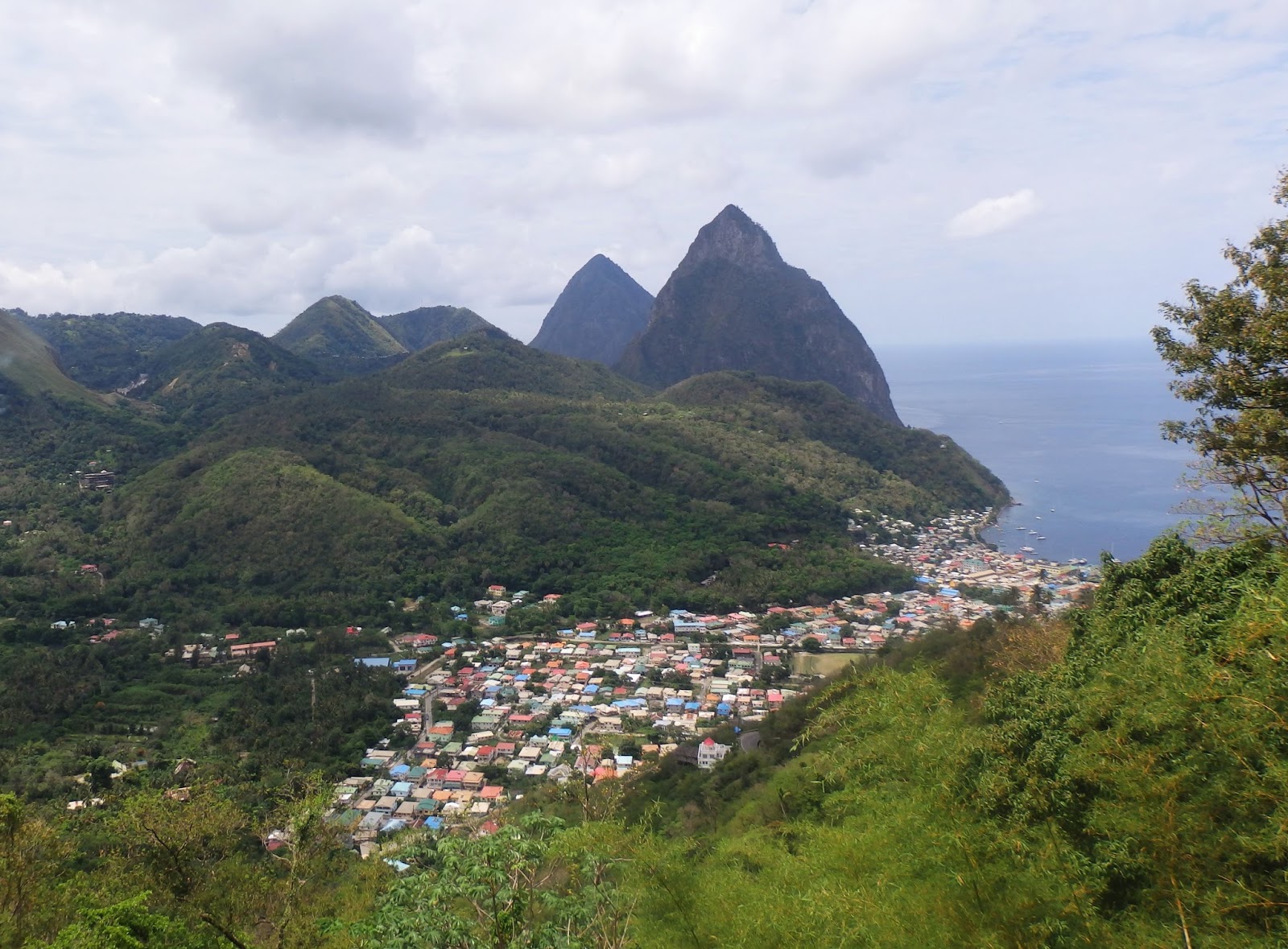
The lovely view from the chef's house where we were served lunch.

We dined at the home of a chef, which was surrounded by lush trees and offered stunning views overlooking the island. Lunch was an assortment of native fried foods and exotic fruits, freshly prepared. We felt privileged to be welcomed into the home, and were encouraged to tour the beautifully furnished rooms, although I’m sure the chef enjoys a lifestyle above the average St. Lucian. It was difficult to tear ourselves away from the gracious hospitality and the lovely backdrop, but our driver insisted we had much more to see.

Twin Pitons:  Our next stop was an overlook of the town of Soufriere and a stunning view of the dramatic Twin Pitons. It was amazing to see the most famous sight on the island right in front of our eyes. I had waited for this moment for a long time! The Pitons are two beautiful, volcanic spires covered in emerald vegetation, which rise out of the sea. Gros Piton is over 2,600 feet above sea level, and is actually easier to climb than Petit Piton, nearly as tall at about 2,450 feet. It takes most hikers, using guides, between 3 and 5 hours to climb to the top of the steep and rocky volcano. The Pitons, a UNESCO World Heritage Site, are the most photographed landmark of St. Lucia, and a local brand of beer is named for them, “Piton” (which was mighty tasty, by the way.)  

View of the Pitons from an overlook

I always try to taste the local beer!

Soufriere was St. Lucia’s first settlement, founded by the French in 1746. Soufriere Volcano, known as Sulphur Springs, is the world’s only drive-in volcano. We expected a volcano more similar to the ones in Hawaii Volcanoes National Park. However, this dormant volcano does not have magma, but steamy and odorous sulfur gases released from several dozen fumaroles (steam vents) in the bubbling mud. In the 1800’s, sulfur was mined here. Observation decks allow views of the seven acre site, and guides give history and answer questions.

Sulphur Springs also offers hot spring mineral-rich mud baths, which are believed to have a healing, restorative effect on the body. A woman in our group had heard glowing reports of this experience from a friend who had traveled here, so she had planned this cruise with the sole intention of immersing herself in the bathing pools of purifying mud. Sadly, no one else in our party was willing to join her in the 110 degree F. baths on a hot day. I was tempted to try the experience, but I really needed to cool off, so I headed with the tour guide to nearby Toraille Falls.
 
Toraille Falls’ cool water drops 50 feet over a cliff, cascading into a pool in a beautifully landscaped garden. The pond is surrounded by a semicircular wall of ferns and greenery, reaching straight up to the top of the waterfall. It was like swimming at the base of a terrarium, and is an experience I will never forget. Only one other person “swam” in the shallow pond, although it can get quite crowded. The pounding waterfall provided an invigorating back massage, the cool water was very refreshing, and I didn’t want to leave! Changing booths are available here for those who want to take part in the mud baths or the waterfall.


Pictured right:  Me, on the left, with a new friend enjoying the waterfall and pond.


After changing, we watched the cute goats climbing on the hills with such sure feet, then drove through the fishing village of Anse-le-Ray. This village of lesser means is sustained by one of St. Lucia's main traditions, fishing in dug-out canoes. We could see fishermen in the distance, standing in their boats, casting and hauling in their nets for the daily catch.

Soufriere Beach is covered with dark sand that we did not find particularly pretty. There are many amazingly beautiful beaches in St. Lucia, but we were at this beach mainly for the view. This beach is popular with the locals, and it offers a vista of one of the Pitons. On the opposite side of the beach is a very large rock formation with a rare natural window, jutting out of the sea.  
We were intrigued as vehicles slowly made their way up the very steep, narrow road next to the beach. On the far side of that hill is “the nicest resort on the island”, according to our guide. There are numerous hotels and luxury resorts scattered around the island.
The guide drove us through Gros Islet, another fishing village, and he described a fun weekly street party that takes place there. Family and friends meet up for drinks on Friday nights, at the end of the work week. The colorful carnival scene features soca and reggae music and a "jump up" (dancing in the streets). I would have loved to participate in that custom and mingle with the locals!
Our tour guide drove us high above Marigot Bay to show us a panoramic view of “the most beautiful bay in the Caribbean”, according to author James A. Michener. Marigot Bay is unique in that it has a spit of land that stretches out toward the middle of the bay.  Several movies have been filmed here, including Pirates of the Caribbean, and in 1967, Dr. Doolittle’s beach scene with the giant pink snail.

Left, the beautiful Marigot Bay


The guide returned us to the cruise terminal, and we thanked him for an educational day.  We boarded the ship with an appreciation for the people and the culture of St. Lucia.

Our ship began it’s late afternoon sailaway from Castries, and I watched the passing views from the top deck in the late afternoon sunshine. The captain sailed slowly along the coast and over to the Two Pitons, where he halted the ship to allow time for the passengers to enjoy a close-up view from the sea. He slowly turned the ship so that everyone could appreciate the view of the Pitons, so close it felt as if you could touch them. We could not truly appreciate their large size until another cruise ship passed and was quickly dwarfed by the Pitons. The setting sun slowly changed the colors and appearance of the mountains, and we departed St. Lucia, a new favorite island in the Caribbean.


Our cruise ship stopped for this view, and 
another cruise ship sailed even closer to the Pitons.
Have you visited beautiful St. Lucia? If so, what was your favorite thing to see or do while there? Would you like the challenge of hiking the Grand Piton? Would you take, or have you taken, a mud bath? Or would you prefer, like me, to cool off under a refreshing waterfall in a 50’ tall terrarium? I'd love to hear your thoughts!
Psalm 121:1-2:    
"I lift up my eyes to the mountains—where does my help come from?  
My help comes from the Lord, the Maker of heaven and earth."

Wednesday, December 13, 2017

Swaziland Adventures: Antelope, Laundry, and Superwoman

Laundry and Other Adventures in Swaziland 


What began as a simple attempt to wash our clothes in a coin laundry ended with damp clothing strewn across the back of our car while we drove through Swaziland. Oh, and an antelope and Superwoman were involved in this adventure, too.
My husband and I had explored in great depth all the lodging options available for our month-long trip through South Africa and Swaziland. Our goal (well, to be honest, it was my goal) was to experience every type of lodging available in South Africa and Swaziland. Our reservations included a motel, "luxury" tent, hut, game lodge, rondavel (circular mud hut with grass roof), resort, treehouse (my husband's favorite), backpackers' lodge, and bed and breakfast.
"Welcome" sign at the South Africa/Swaziland Border Control.

On our first day in Swaziland, we had reservations in a "beehive", a traditional Swazi hut with thatching over a rounded wooden frame. Beehives have a low entrance only about 3 1/2 feet high (just over a meter) and several feet thick; it requires stooping to enter, making it difficult for enemies to attack and enter, and for tourists to drag their luggage in without throwing out their backs.
 
This hut is named a “beehive” due to it’s appearance. The modern bathroom is attached in the rear.

We drove from South Africa to the dusty roads of Swaziland, arriving at beautiful Mlilwane Wildlife Sanctuary in the hot afternoon.  Our first stop after visiting their small museum was to check in at the office adorned with curtains hung on rods supported by antlers.  I inquired about the laundromat, as we had read that a laundromat was available on the premises, and we had planned to launder our clothes at this point in our trip.  We were informed that there was but one washer and one dryer.
Office personnel then directed an employee, who was about 70 or more years old, to show us to our lodging. This woman, whom I'll call "Superwoman", spoke very little English, so she motioned for us to drive behind her while she walked ahead very rapidly on the dusty road.  She continued her very fast pace for several blocks, past the "Beware of the Hippo" sign and to the parking area, where she attempted to unload our luggage, although we insisted we could do this ourselves. 

Superwoman ducked into the lodging with great agility and waited for those of us who are not so flexible to struggle inside. She demonstrated how to close the "door", a 3' x 3.5' piece of plywood that slid across the entrance. Well, most of the entrance. There was a 4" gap at the top, I suppose for ventilation. A key was produced that secured a bicycle-type padlock.  This was definitely not luxury nor high-tech lodging.    

The thatched roof over the low door.


Looking out from the hut, you see the short plywood door with "lock" that slides across the very low entrance. .

Laundering surprises

I communicated to Superwoman through gestures that I wanted to launder our clothes, and she indicated she would perform this task for us.  I don't know if it was pride or embarrassment that prevented me from allowing her to do so, but to be honest, I was too embarrassed to allow a very slim African lady to wash our much larger American underwear. So I filled a rolling suitcase with our dirty clothes, and followed her as she led the way to the laundromat.

Superwoman set out, passed the "Beware of the Hippo" sign again, and made tracks so quickly that I struggled to keep up with her. Of course I was pulling a (somewhat) heavy bag, which she again indicated she would pull, but I would have been embarrassed to have an older woman helping me. Thus, I continued to trudge behind her, falling further behind, wishing desperately that I had attended my aerobics classes on a more regular basis.  Due to her rapid mobility, I was beginning to wonder if she knew where that hippo was.
Upon arrival at the "laundromat", I noted that the single washer and dryer were situated on a cement pad open to the elements except for the wall behind it and a 6' (2 meter) "roof" over it. A sign on the dryer said "Out of order", and the woman pointed out a large number of clotheslines hidden from view inside a mostly fenced-in area. I have absolutely no idea why there was such an abundance of clotheslines, considering that there was only one washing machine.  
Superwoman reached out to take my coins for the washer's coin slot, but indicated that I could not use my South African coins.   I don't know why, but I had failed to consider I would need coins from tiny Swaziland. She hurried me back to the front desk to obtain Swazi coins. They did not have any, but suggested trying the park's nearby store. I asked if they had clothespins I could borrow, but they had none. "This should be interesting," I thought, as my elder friend and I practically jogged to the store, hoping for the elusive coins.
Luckily, I was able to purchase the correct coins from the store's cashier, and Superwoman and I rushed back to the "laundromat". She continued to be “helpful” by trying to place my laundry into the washing machine, but I thanked her and indicated again that I would launder it myself.  
Lastly, she picked up the electrical cord to the washing machine, plugged it in, and indicated that I should unplug it when finished.  I suppose that was to prevent electrical shock due to the exposed machine; I don't know why that didn't concern me at the moment. I was probably too exhausted from the dusty drive and the intense heat.  I thanked her again, as Superwoman hurried away to assist the next guests.
With the laundry in the washer, the correct coins inserted in the machine, and an electrical cord now providing power, I wandered back (not quickly) to find my exhausted husband sound asleep in the stifling beehive. (He's exhausted?) I made sure that the attached modern bathroom had it's window open, and left the sliding door ajar for more fresh air and circulation, hoping that the hippo was not flexible enough to duck under the roof and fit inside the door.  I picked up my camera and went to explore the area.
I walked past the "Beware of the Hippo" sign and made my way to the restaurant to review the dinner menu, since I had worked up an appetite with all my hiking and jogging.  Butternut soup was the starter tonight, and the main course was chicken casserole, pork roast, and hake goujons (fried fish similar to cod); dessert was chocolate pudding, and tea and "filter coffee" was available. Coffee is not a common drink in the area, so instant coffee is usually served, although tourists prefer their coffee brewed with a filter. The menu seemed interesting, and I loved that we could dine outdoors surrounded by rails for safety, so I made reservations for later in the evening.
Afterwards, my stroll took me by the pool that overlooked beautiful mountainous scenery. The view was quite stunning, so I took photos while enjoying God's handiwork.
View of the Mlilwane Wildlife Sanctuary land from the pool
I met guests from around the world, and we chatted and compared our African journeys so far. They warned me to take seriously the "Beware of the Hippo" sign that was between my beehive and my dinner.

Maybe they shouldn't have told the hippo where the restaurant is!

Once the washer had completed it's job, I placed the damp load into my suitcase and wheeled it across the grass to the mostly-enclosed fenced area to hang the clothes on the lines. I rounded the corner and was surprised by a wild antelope eating the grass beneath the clotheslines, but he ignored me.  He seemed comfortable with a startled tourist hanging laundry in the middle of his salad plate.  I'm not sure why I wasn't more afraid of the antelope, but I began my chore warily at the line furthest from him. After awhile, I didn't much notice the antelope, and he didn't bother me as he continued to graze quietly. The blue jeans and shirts were not difficult to hang on the line without clothes pins, and I eventually became proficient at hanging all items on the line. My biggest fear was that the clean clothes would fall down into the generous amount of antelope poo beneath the lines.

Our wash on the many clotheslines (because you need this many clotheslines for one washing machine, right?)


Hungry antelope eating his dinner and, luckily, not our laundry.
My task completed, I returned to exploring and chatted with more guests.  I returned to the laundry to ensure that our clothes were still on the line and that the antelope had not decided to chew on the jeans.   I didn't see him again, but thought perhaps he had been having dinner in the enclosed area because he was afraid of the hippo.
In the evening, my husband and I, along with the other guests, used flashlights to illuminate the dark road to the dining area, keeping our eye out for the hippopotamus. Safety in numbers, right? The dining area was beautifully decorated with hand-woven basketry; individual candle-lit tables were set with lovely native tableware and linens, and the buffet was very colorful and tasty.


We ordered some wine, and it arrived in the most decorative bottle I've ever seen. The dessert was delicious, the service was good, and the facilities were quite nice, with lovely bathrooms and artwork.

Isn't this the most beautiful bottle of wine?

Cultural Dance

After dinner, the staff performed a cultural show for the guests.  Drummers signaled the beginning of the show around a brightly burning fire.  The performers began with native songs and dances, dressed in traditional Swazi costumes. They danced individually and in groups, often kicking one leg high above their heads. I know my body could not even come close to some of these moves, performed by both men and women.  Sometimes the men would dance together, often imitating a hunt with their "spears", then the women would dance and sing harvest songs, among others.  (I recorded video of the event, but because it was so dark, it cannot be clearly seen.  We attended a similar show the following day, and I have excellent video of that performance for my next Swazi post.)

The men, dressed as antelope, performed a hunting dance.

One of the female performers looked familiar, even in the dim light of the campfire. It was Superwoman! She recognized me too, and seemed so very happy to see me enjoying the performance. She waved to me excitedly, as if I were her long-lost friend. Guests were invited to dance with the natives, and Superwoman quickly (of course) ran over to me, grabbed my hand, and pulled me up to dance around the fire with her.  In spite of our trouble with language differences, I felt like she was my best friend ever! I have a friend in Swaziland! 


"Superwoman" , my best Swazi friend, 
held my hand in friendship as we danced.


"Let them praise His name with dancing and make music to Him with timbrel and harp." Psalm 149:3


With the performance finished, I thanked my best Swazi friend for the opportunity to take part in her native dance, and said good night.  My husband and I stopped to check on our laundry, which was still damp. We questioned leaving it overnight but decided that, since it was hidden behind a fence, most people had no idea it was there. No hippos to be seen on the way to our lodging.
The modern shower in our beehive was very welcome, but the beds were very uncomfortable and the air was still very warm without air conditioning. The ceiling fan provided some welcome circulation, and in spite of the warmth and uncomfortable bed, we slept very well. I made a mental note to make sure I booked lodging with air conditioning the next time we visit Swaziland!


Uncomfortable beds in the hot beehive; notice the large water bottle 
between beds.  We bought all our water for health reasons.
In the morning the laundry was dry, with the exception of the very damp jeans and socks, but we needed to hit the road. The dry items were packed, but the jeans were spread out in the back seat and the back window of our car.  Socks were hung from the front headrest and the back seat belts. The sun and the wind would dry the laundry today!
We checked out of the beehive, agreeing that the idea of sleeping there was more enticing than the actual experience.  However, the cultural experience was amazing and will forever be remembered.  We never did meet the resident hippo; we did not see Superwoman again.  
I miss my best Swazi friend.
Tags:  Swaziland, Mlilwane Wildlife Sanctuary, beehive, native culture, dancing, hippopotamus, antelope, South Africa, wine


Wednesday, November 22, 2017

About Me

Why a new travel blog, and why would you enjoy reading it?

Let me introduce myself. My name is Mary Prentkiewicz, and I would like to share with you my passion for travel and photography. Having lived with my family on three continents and seven of the United States, we have had a great number of opportunities for travel and exploration.  Each of our 20 moves means beginning again in a new city or country, but it also expands our lives in multiple ways, contributing to our understanding and love for other people and cultures.


The author in Budapest, Hungary

I followed my passion for travel by operating my own travel business for six years.  My husband retired early, and now we are able to travel more often, sometimes for long periods of time, and as such, we need to be budget conscious. We do splurge on the occasional vacation, or portion of a vacation, but generally we try to be frugal, and I will share my tips with you.  We are also now more aware of the needs of the handicapped, so I will try to incorporate some tips for those needing special accommodations as well.

Some of the locations I will describe include: 
  • England and Japan, having lived three years in each location 
  • Bangkok, Thailand
  • Beijing, China
  • Israel's Holy Land
  • Queensland and New South Wales, Australia
  • Krakow, Poland
  • St. Petersburg, Russia
  • Portugal and Spain
  • South America 
  • Denmark and Sweden
  • One month driving in South Africa on our own, and a guided 3 week tour in Kenya
  • Three weeks sightseeing by car through New Zealand
  • Four nights as the only foreigners on a Russian ferry
  • A humorous adventure in Swaziland
  • European river cruise villages and large cities
  • Favorite cruise ship ports throughout Mexico, the Caribbean, Europe, South America, and around the world; and
  • Favorite places in America, including Mackinac Island, Michigan; Sedona, Arizona; Washington, D.C.; Alaska; and some beautiful National and State Parks.

The author in the beautiful, windy Azores.

God has created such a beautiful world, and we are so grateful to be able to explore so much of it. I am by no means a professional photographer, but I do love taking photographs to capture the essence of a location; I spend a great deal of time looking for that “perfect shot.”
Why "Traveling Through This World?"  I greatly admire the evangelist Billy Graham, and all the work he did for the Lord.  One of his famous quotes was  "My home is in Heaven.  I am just traveling through this world."  That we are, Billy.  And what a beautiful world it is!  

I hope you will join me on my journey.  I would love to hear of your adventures and see your travel photos too.  Welcome to Traveling Through This World!